Missing teeth can affect much more than the appearance of your smile. Tooth loss can make chewing more difficult, affect the way you speak, and cause you to feel less confident when smiling or interacting with others. Fortunately, modern dentures can restore both the function and appearance of your smile.
But if you've lost teeth, how do you know whether you need full or partial dentures?
The answer depends primarily on how many teeth you're missing, the health of your remaining teeth, and your overall oral health and goals. At Roman Dental Arts in Hackensack, NJ, we offer both partial and full dentures, as well as implant-supported dentures, so your treatment can be tailored to your specific needs.
Here's what you should know about the difference between full and partial dentures and when each option may be appropriate.
What Are Dentures?
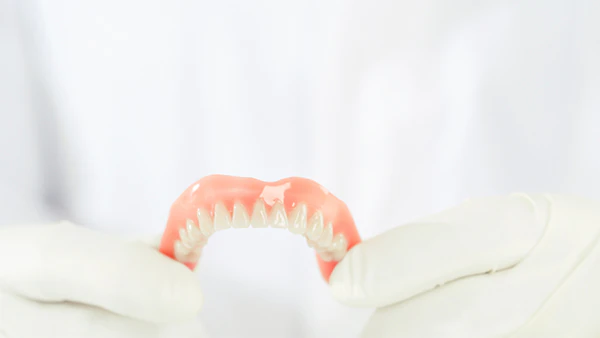 Dentures are removable dental restorations designed to replace missing teeth. They are custom-made to fit your mouth and restore important functions such as chewing and speaking while also supporting the appearance of your smile.
There are two primary types of conventional dentures:
- Partial dentures, which replace several missing teeth while working around your remaining natural teeth
- Full dentures, which replace all of the teeth in the upper arch, lower arch, or both
At Roman Dental Arts, dentures are designed with comfort, stability, and a natural appearance in mind. Patients may also be candidates for implant-supported dentures, which use dental implants to provide additional support and stability.
What Are Partial Dentures?
A partial denture is designed for patients who are missing several teeth but still have healthy natural teeth remaining.
Rather than replacing an entire arch, a partial denture fills in the spaces created by missing teeth. Depending on the design, it can help restore your ability to chew while preventing the remaining teeth from being left without support.
When Might You Consider Partial Dentures?
Partial dentures may be an option when:
- You are missing several teeth but still have healthy natural teeth
- Missing teeth are located in different areas of your mouth
- A bridge or dental implant isn't the preferred solution for your situation
- You want a removable option for replacing multiple teeth
- Your remaining teeth can provide appropriate support for the restoration
The condition of your remaining teeth is an important consideration. If some of your natural teeth are severely damaged or cannot provide adequate support, your dentist may recommend addressing those teeth before determining whether a partial denture is appropriate.
What Are Full Dentures?
Full dentures, also called complete dentures, replace an entire arch of teeth.
You may need a full denture for the upper jaw, lower jaw, or both. Full dentures are generally considered when all of the natural teeth in an arch are missing or when the remaining teeth are no longer healthy enough to preserve.
A complete denture can restore the appearance of your smile while providing a replacement for teeth that are no longer present.
Full vs. Partial Dentures: What's the Difference?
The biggest difference is the number of natural teeth remaining.
With a partial denture, some natural teeth remain in the arch. The denture is designed around those teeth to replace the missing ones.
With a full denture, an entire arch of teeth is being replaced.
Your dentist will evaluate your teeth, gums, bite, and overall oral health before recommending either option.
When Are Partial Dentures Usually a Better Fit?
If you still have several healthy natural teeth, preserving those teeth is generally an important part of your treatment plan.
Partial dentures can be useful when the remaining teeth are healthy enough to remain in place but there are too many missing teeth to replace easily with individual restorations.
For example, imagine you're missing several molars on one side of your mouth but have otherwise healthy front teeth and other back teeth. A partial denture may provide a way to replace those missing teeth without removing healthy teeth simply to create space for a full denture.
However, every patient's situation is different. A dental bridge, individual dental implants, or another restorative option may also be appropriate depending on the location and number of missing teeth.
When Are Full Dentures Usually a Better Fit?
Full dentures may be considered when an entire arch has lost its natural teeth or when the remaining teeth are severely compromised.
For some patients, removing teeth that cannot be predictably restored and replacing the entire arch with a complete denture can provide a more functional and maintainable solution.
Your dentist will consider whether any remaining natural teeth can and should be preserved before recommending complete tooth replacement.
At Roman Dental Arts, restorative treatment is centered around preserving natural tooth structure whenever possible while providing appropriate solutions when teeth cannot be saved.
What If I Still Have Some Teeth but They're Not Healthy?
This is where a comprehensive dental evaluation becomes especially important.
Having some teeth remaining doesn't automatically mean that a partial denture is the right choice. Your dentist needs to determine whether those teeth are healthy enough to keep.
Depending on the situation, treatment could involve:
- Restoring damaged teeth with fillings or crowns
- Treating gum disease
- Replacing individual teeth with dental implants
- Removing teeth that cannot be saved
- Using a combination of restorative treatments
The goal isn't simply to determine whether you need a full or partial denture. It's to create a treatment plan that supports your oral health and function over the long term.
What About Implant-Supported Dentures?
Traditional dentures aren't the only option for replacing multiple missing teeth.
Implant-supported dentures combine dentures with dental implants. Rather than relying entirely on the gums for support, the denture is stabilized by implants placed in the jaw.
This can provide additional stability and may be particularly appealing to patients who are frustrated by loose or uncomfortable traditional dentures.
Dental implants can also be used in other ways to replace missing teeth, including individual implant-supported crowns and implant-supported bridges.
Roman Dental Arts offers dental implants as a permanent tooth replacement option and provides implant-supported dentures for patients seeking additional stability.
Full vs. Partial Dentures: Factors to Consider
Choosing between full and partial dentures isn't simply about counting the number of teeth you're missing. Your dentist will consider several factors.
The Number of Missing Teeth
If you have several natural teeth remaining, a partial denture may be possible. If an entire arch is missing or the remaining teeth cannot be predictably restored, a full denture may be more appropriate.
The Health of Your Remaining Teeth
Healthy natural teeth can provide important support and function. Your dentist will evaluate the condition of your remaining teeth before recommending a partial denture.
Your Gum and Bone Health
The condition of your gums and supporting bone affects how well a removable restoration can function. Periodontal disease, for example, may need to be addressed as part of your overall treatment plan.
Your Lifestyle
Consider how you want your replacement teeth to function in your everyday life. Some patients are comfortable with a removable restoration, while others prefer the stability of dental implants.
Your Long-Term Goals
Dentures can restore your smile and function, but they're not the only tooth replacement option. Depending on your circumstances, dental implants or implant-supported dentures may offer another approach.
Your dentist can explain the advantages and limitations of each option so you can make an informed decision.
Can Dentures Look Natural?
Modern dentures are designed to look much more natural than the stereotypical "false teeth" many people imagine.
Your denture can be customized to complement your facial features, smile, and existing appearance. The goal is to replace missing teeth in a way that looks natural while restoring function.
At Roman Dental Arts, restorative dentistry combines function with aesthetics. The practice uses modern technology and individualized treatment planning to create restorations designed around each patient's needs.
What Happens If I Don't Replace Missing Teeth?
It may be tempting to leave missing teeth alone if they're not causing immediate pain. However, tooth loss can affect your oral health and function over time.
Missing teeth can contribute to:
- Difficulty chewing
- Changes in speech
- Shifting of remaining teeth
- Changes in your bite
- Loss of bone in areas where teeth are missing
- Changes in facial support
Replacing missing teeth can help restore function and reduce some of the complications associated with untreated tooth loss.
Do I Need Full or Partial Dentures?
The answer depends on your unique smile.
Partial dentures may be appropriate if you are missing several teeth but have healthy natural teeth remaining.
Full dentures may be appropriate when an entire arch of teeth is missing, or the remaining teeth cannot be predictably restored.
And for some patients, neither traditional option is the only choice. Dental implants and implant-supported dentures may provide additional possibilities for replacing missing teeth. The best way to determine the ideal restorative treatment for you is to have your teeth, gums, bite, and overall oral health evaluated by your dentist.
Learn More About Full and Partial Dentures in Hackensack, NJ
If you're missing teeth, you don't have to navigate your options alone.
At Roman Dental Arts in Hackensack, NJ, Dr. Donald Roman and Dr. Alissa Roman provide comprehensive restorative dentistry designed to restore the strength, comfort, and function of your smile. The practice offers partial dentures, full dentures, implant-supported dentures, dental implants, bridges, crowns, and other restorative treatments.
Because multiple tooth replacement options are available, your treatment can be based on your individual oral health, goals, and preferences rather than a one-size-fits-all approach.
If you're wondering whether you need full or partial dentures in Hackensack, NJ, schedule a restorative consultation with Roman Dental Arts. Your dental team can evaluate your smile, explain your options, and help you determine the next step toward restoring your oral health and confidence.